5002 Lakeland Circle, Suite B, Waco, Texas 76710


That disorienting, spinning sensation can turn your world upside down in an instant, making even simple tasks feel monumental. If you're also dealing with neck pain, you’re not just imagining the connection. What you might be experiencing is cervicogenic dizziness, a condition where problems in your neck are the direct cause of vertigo.
Many people right here in Waco, TX, live with this frustrating cycle of dizziness and neck pain without getting a clear diagnosis or finding effective relief. At Victory Spinal Care, we understand how debilitating this feeling can be, and we're here to help you find a lasting solution. If you're searching for a "chiropractor near me" who specializes in the complex relationship between the neck and balance, you've come to the right place.
Table of Contents
That unsteady, spinning feeling is deeply unsettling, affecting everything from your ability to work to simply walking across a room with confidence. When this dizziness appears alongside neck pain, stiffness, or headaches, it’s a strong clue that the source of your balance problem may not be your inner ear, but your neck itself.
This guide is for anyone in Waco tired of dizziness controlling their life and looking for a real, lasting solution. We've seen too many patients suffer for months or even years, jumping from one treatment to the next, only to mask the symptoms without ever getting to the root cause. Here at Victory Spinal Care, our local Waco chiropractic clinic, we want you to know there is hope.
In our Waco chiropractic clinic, we don't just chase symptoms. We focus on a specific, gentle, and precise approach called upper cervical chiropractic care. This method is designed to address the underlying structural problem in your upper neck that can trigger vertigo and dizziness, providing relief for conditions that often lead patients to seek an auto injury chiropractor or a neck pain chiropractor.
The connection lies in the incredibly dense network of nerves at the very top of your spine. These nerves are in constant communication with your brain's balance centers. When the top two vertebrae—the atlas (C1) and axis (C2)—are even slightly misaligned, they can disrupt these critical nerve signals. Think of it like static on a phone line; the interference scrambles the information your brain needs to understand your body's position in space, leading directly to that disorienting feeling of vertigo.
Our goal is simple: find the exact source of that interference and correct it, allowing your body to heal and restore its natural sense of balance. We do this without any forceful twisting, popping, or cracking.
Throughout this guide, we'll break down:
If you’re looking for a chiropractor in Waco, TX who truly understands the complex relationship between your neck and your sense of balance, you've found the right place. Let's walk through this often-misunderstood condition and show you a clear path toward stability and a life free from dizziness.
It might seem odd that a stiff neck could make you feel like the whole room is spinning, but the connection is surprisingly direct. Your sense of balance isn't handled by just one part of your body. It’s a complex team effort coordinated by your brain, which relies on constant, accurate information from three key systems: your inner ears, your eyes, and the nerves in your neck.
Think of the nerves in your upper neck as a high-speed data cable. They're packed with tiny sensors called proprioceptors that are constantly firing off messages to your brain about where your head is positioned in space. This stream of information is absolutely vital for your sense of balance and coordination.
When everything is working smoothly, your brain integrates all these signals without a hitch, giving you a stable, clear sense of your surroundings. But when the delicate alignment of your upper neck gets thrown off, that data cable starts sending corrupted files.
The top two vertebrae in your spine—the atlas (C1) and the axis (C2)—are built differently from the rest. Their unique shape is what allows your head to turn, tilt, and nod so freely. But that incredible mobility comes at a cost: they're also more vulnerable to being knocked out of alignment by things like an auto injury, years of poor posture at a desk, or even just chronic stress.
When these vertebrae shift out of place, they can irritate or compress the sensitive nerves all around them. This irritation distorts the proprioceptive signals heading to your brain.
Suddenly, your brain is getting conflicting reports. Your eyes might say, "We're standing still." Your inner ear agrees. But the scrambled signals from your neck are screaming, "We're tilting and turning!" This sensory mismatch is precisely what triggers that disorienting feeling of vertigo, dizziness, or general unsteadiness.
This flowchart shows just how a neck problem can become a balance problem—and how fixing the neck is the key to relief.
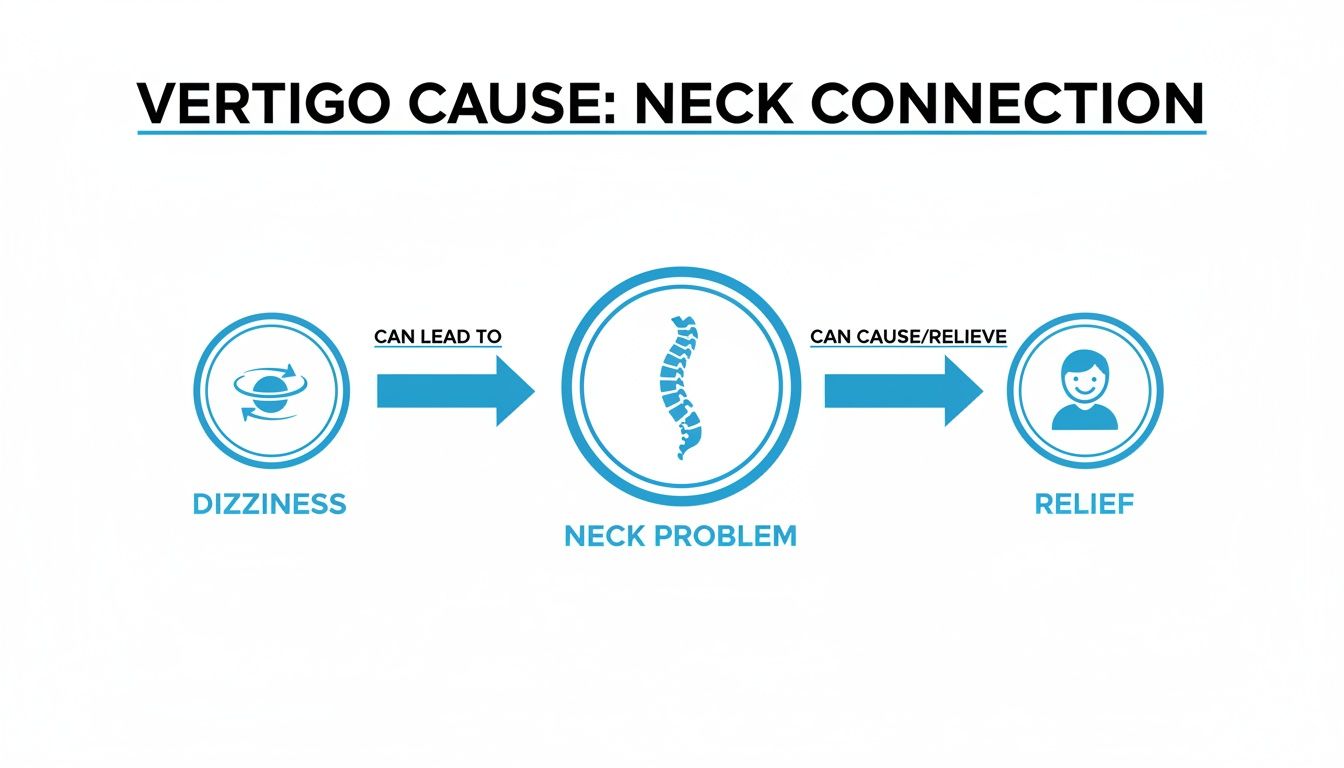
It’s a clear progression: the neck issue is the root cause of the dizziness, and addressing that spinal problem is the pathway to feeling steady again.
This is why many people in Waco who come to our clinic for neck pain chiropractic care are often surprised when their dizziness and balance issues also start to fade. The two problems are frequently just different symptoms of the same underlying issue: an upper cervical misalignment.
If you're dealing with dizziness, you're in good company. Dizziness and vertigo affect a staggering 15% to 20% of adults each year, and a huge number of these cases are rooted in neck problems.
In fact, one study found that among patients with balance disorders, a whopping 75% also reported having neck pain. The connection is powerful, and exploring how these symptoms overlap can be the first step toward finding the right solution.
This specific condition is called cervicogenic dizziness, meaning "dizziness originating from the neck." It tends to show up with a few tell-tale signs. Ask yourself if any of these sound familiar:
Recognizing these patterns is a huge clue. Differentiating this from other types of vertigo can be tricky, but understanding the key differences can point you in the right direction.
Use this table to help identify whether your symptoms align more closely with cervicogenic dizziness or other common vertigo triggers.
| Symptom or Characteristic | Vertigo from Neck Problems (Cervicogenic) | Inner Ear Vertigo (BPPV, Meniere's) | Central Vertigo (Brain-Related) |
|---|---|---|---|
| Primary Trigger | Neck movements or holding a specific head position. | Often triggered by changes in head position, but can be spontaneous. | Can be constant and unrelated to movement. |
| Associated Symptoms | Always accompanied by neck pain, stiffness, or headaches. | Usually involves hearing loss, tinnitus (ringing in ears), or a feeling of ear fullness. | Often comes with neurological signs like double vision, slurred speech, or weakness. |
| Duration of Episodes | Can last for hours or even days. Often described as "unsteadiness" rather than true spinning. | BPPV is very brief (under a minute). Meniere's episodes can last 20 minutes to several hours. | Can be persistent and last for long periods. |
| Nausea and Vomiting | Usually mild or absent. | Can be severe, especially during intense spinning episodes. | Varies, but can be present. |
| Hearing Issues | None. Hearing is not affected. | Hearing loss and tinnitus are hallmark signs of inner ear issues. | Not a typical symptom. |
While this table is a helpful guide, a proper diagnosis is crucial. At Victory Spinal Care, our detailed examination is designed to get to the bottom of your symptoms. We focus on determining if an upper cervical issue is the true cause of your vertigo, which allows us to provide the precise, gentle care needed to restore both your alignment and your sense of balance.

The key to finding lasting relief from vertigo caused by neck problems isn't about masking symptoms with medication. It’s about getting to the root of the problem and correcting the communication breakdown between your neck and your brain. This is where the specialized, gentle approach of upper cervical chiropractic care at Victory Spinal Care makes all the difference for our patients here in Waco.
Unlike general chiropractic that might focus on the entire spine, our work is centered exclusively on the top two vertebrae—the atlas (C1) and axis (C2). Think of this area as the critical junction where your head meets your neck. It’s a delicate and incredibly important region for your body's balance and nervous system function.
When you visit our Waco office, our very first priority is to understand exactly what’s happening at the top of your spine. We don't guess. We use precise, state-of-the-art diagnostic imaging to get a crystal-clear picture of your unique anatomy and pinpoint the exact angle of any misalignment.
This detailed analysis allows us to tailor a correction specifically for you.
The adjustment itself is one of the most reassuring parts of the process for our patients. It is incredibly gentle, with no twisting, popping, or cracking of the neck. Many people are surprised by how light and controlled the touch really is.
This precision is what makes our approach so effective. We aren’t forcing anything into place; we are simply providing a calculated, gentle nudge that allows your body to guide the vertebrae back into their natural, optimal position.
By restoring proper alignment with this light, controlled touch, we effectively reopen that vital communication highway between the nerves in your neck and your brain's balance centers. The "static" that was scrambling the signals begins to clear up, allowing your nervous system to function the way it was designed to.
This single correction achieves several important goals for those suffering from cervicogenic dizziness:
Ultimately, the goal of upper cervical care is to remove interference so your body's innate ability to heal can take over. Once the structural problem is corrected, your body can begin the process of repairing and re-regulating itself. This is why our patients often report not only a reduction in their dizziness but also improvements in headaches, neck pain, and overall stability.
The gentle approach we take at Victory Spinal Care is designed to provide a lasting solution. We want to get you back to living your life in Waco without the constant worry of another dizzy spell. If you're looking for an upper cervical chiropractor who can help you understand and treat the true cause of your symptoms, our team is here to help.
You can learn more about the range of issues that respond well to this specialized approach by exploring some of the other common upper cervical care conditions we address.

Taking that first step toward relief can feel like a big deal, especially when you’re not sure what’s involved. We get it. At Victory Spinal Care, our goal is to make your first visit to our Waco clinic a clear, comfortable, and reassuring experience from the moment you walk through our doors.
Your journey with us doesn’t start with a rushed exam; it starts with a conversation. We believe listening is one of the most powerful diagnostic tools we have. We’ll sit down with you to go over your health history, understand the specific symptoms you’re dealing with, and learn how this feeling of unsteadiness is affecting your life.
Once we’ve heard your story, the next step is a comprehensive examination designed to get to the true source of the problem. Because vertigo caused by neck problems demands a precise diagnosis, we don’t do any guesswork. Our entire process is built on objective, advanced diagnostics.
We’ll perform specific orthopedic and neurological tests to assess your spinal function, balance, and nervous system health. This helps us see exactly how your body is functioning and pinpoint where the communication breakdown between your brain and your neck might be happening.
To get a crystal-clear picture of what's going on, we use state-of-the-art imaging of your upper cervical spine. This lets us see the exact position of your atlas (C1) and axis (C2) vertebrae. This step is absolutely critical, as it reveals the precise misalignment that could be interfering with your body's balance system.
We believe in total transparency. After your exam, we’ll sit down with you to review our findings in detail. We'll show you your images and explain exactly what’s happening in your neck, connecting the dots between the spinal misalignment and the vertigo you've been experiencing.
Our commitment is to ensure you feel completely informed and empowered. You will have ample time to ask questions and will leave with a clear understanding of the root cause of your dizziness and a personalized care plan designed to correct it.
Together, we’ll map out your road to recovery. This plan will outline the recommended care, what to expect from your adjustments, and the timeline for your progress. Feeling confident and informed is a key part of the healing process, which is why we also provide resources explaining details like how long a chiropractic adjustment takes to set clear expectations from day one.
Our entire Waco team is here to support you on your path back to feeling stable, balanced, and like yourself again.
How can you tell if that dizzy, off-balance feeling is actually coming from your neck? While a professional diagnosis from a specialist is always the best course of action, there are several key patterns that often point straight to a neck-related cause.
Unlike the violent, room-spinning sensation of inner ear vertigo, vertigo caused by neck problems typically feels more like a general sense of unsteadiness or lightheadedness. Many of our patients in Waco describe it as feeling like they’re walking on a boat, or a strange sensation that their head is disconnected from their body.
What’s most important is that these feelings are almost always linked directly to what’s happening in your neck. That connection is your biggest clue.
The symptoms of cervicogenic dizziness are often triggered or made worse by specific neck movements and postures. As you go about your day, start paying close attention to whether that unsteady feeling gets worse when you do certain things.
Do you notice the dizziness flares up after:
If you answered yes, that’s a strong signal that the issue is coming from your cervical spine. The dizziness is also often joined by a distinct set of related symptoms.
A key takeaway is that cervicogenic dizziness rarely travels alone. It is almost always accompanied by other neck-related symptoms, such as pain, stiffness, or a reduced range of motion.
Beyond the dizziness itself, most people with this condition also experience a cluster of other symptoms that help confirm the neck's involvement. These are important signs that an atlas misalignment could be contributing to your problem.
Look for these common companions:
Recognizing these patterns in your daily life is the first step toward getting the right help. If your dizziness is consistently tied to neck discomfort and specific movements, it's a clear signal to seek a diagnosis that focuses on your upper cervical spine. Exploring the full range of atlas misalignment symptoms can provide even more clarity.
Ever wonder why vertigo seems to pop up more frequently around middle age? It’s not just in your head. Population-based studies show that vertigo prevalence peaks in the 55–64 age group, and neck problems are a major reason why.
As we get older, degenerative changes like arthritis in the neck (cervical spondylosis) become much more common. A landmark study found that among elderly patients with dizziness, a staggering two-thirds of cases were linked directly to cervical spondylosis. These findings highlight how upper neck dysfunction disrupts your body’s sense of position, leading to that unbalanced feeling. Discover more insights about these age-related vertigo findings on PMC.

While the precise upper cervical care you receive in our clinic is the foundation for treating neck-related vertigo, what you do at home plays a powerful role in your healing. Think of your lifestyle adjustments and gentle exercises as a way to support the corrections we make, helping you hold your alignment longer and speed up your progress.
These tips are designed to work hand-in-hand with your care plan at Victory Spinal Care, not replace it. They are daily tools that empower you to reduce strain on your neck, improve your stability, and protect the hard-won progress you make between visits.
When your neck is the source of dizziness, it's often accompanied by stiffness. However, it's crucial to understand that aggressive stretching can sometimes do more harm than good. The goal here is gentle mobility, not forceful stretching. Simple, controlled movements are the key to easing tension and improving your neck’s range of motion without flaring up the underlying problem.
A fantastic starting point we often recommend is the chin tuck. This simple move directly counteracts the effects of "tech neck" or forward head posture—a major source of strain on the delicate upper cervical spine.
Let's face it, many of us in Waco spend hours at a desk, and a poorly set up workspace can constantly undermine your spinal health. A few small tweaks to your office or home setup can make a world of difference in reducing the daily stress on your cervical spine.
A core principle to remember is keeping your ears aligned directly over your shoulders. This neutral posture is your neck's best friend, minimizing strain on both the muscles and the sensitive joints of the upper spine.
Here are a few simple ergonomic fixes to consider:
Taking these proactive steps is so important because we know neck issues are a primary driver of dizziness. Research has shown that neck-focused rehabilitation strategies lead to significant improvements. For instance, one study found that 40% of cases were linked to disc problems and 45.5% to myofascial pain, showing just how critical it is to address the neck directly. You can read the full research about these neck-related dizziness findings to learn more.
It's completely normal to have questions when you're looking for a new solution to your health, especially for something as frustrating as dizziness. Most of our patients in Waco come to us after trying many other things, so we've put together answers to the most common concerns we hear about upper cervical care and vertigo. We want you to feel clear and confident as you consider taking this step.
This is a fantastic question, as the sensations can sometimes feel similar. Generally, vertigo coming from the neck feels less like a violent spin and more like a persistent unsteadiness or lightheadedness—some people describe it as a "floaty" or "boat-like" feeling. It's almost always paired with neck pain or stiffness and gets worse with certain neck movements or after holding your head in one position for too long (like working at a computer).
Inner ear vertigo, on the other hand (like BPPV), tends to cause an intense, room-spinning sensation. It's often triggered by simple changes in head position, like rolling over in bed or tipping your head back. Our detailed exam at Victory Spinal Care is designed to get to the bottom of which one you’re dealing with.
Every person's healing journey is different, but many of our patients start to notice a real improvement in their vertigo symptoms within the first handful of adjustments. Our goal is to correct the underlying misalignment at the top of the neck, which then allows your body to do what it does best: heal itself.
How quickly you recover depends on a few things, like how severe the misalignment is and how long you've been dealing with it. During your first consultation here in our Waco office, we'll lay out a personalized care plan and give you a realistic timeline of what to expect.
Absolutely not. It's a common misconception that all chiropractic care involves a lot of forceful movement. The upper cervical adjustments we perform at Victory Spinal Care are famous for being incredibly gentle and precise, which often comes as a surprise to our new patients.
We use a very light, controlled contact to correct the alignment of the top two vertebrae. There is no twisting, popping, or cracking of the neck, ever. Most people are pleasantly surprised by how comfortable and relaxing the entire process is.
Yes, you can. Our approach is gentle and safe for people with a wide variety of health conditions. Your first visit always includes a thorough review of your health history to make absolutely sure that our care is a safe and appropriate choice for you.
Because our method is non-invasive and drug-free, it works well alongside other medical treatments you might be receiving. We're always happy to coordinate with your other Waco-area healthcare providers to ensure you're getting comprehensive, integrated care that supports your total well-being.
Are you ready to find out if a misalignment at the top of your neck could be the root cause of your dizziness? The team at Victory Spinal Care – Waco is here to provide the answers and gentle care you need to regain your balance and get your life back.
Schedule your consultation today by visiting us at https://victoryspinalcarewaco.com.