5002 Lakeland Circle, Suite B, Waco, Texas 76710


Sciatica pain can be debilitating, but chiropractic care offers a path to relief by addressing the root cause. Instead of just masking the pain radiating down your leg, a chiropractor in Waco, TX, focuses on correcting the underlying spinal issue that's pinching the nerve. This gentle, non-invasive approach helps restore proper alignment, calm inflammation, and empower your body to heal itself.
Table of Contents

If you’ve ever felt that sharp, shooting pain travel from your lower back, through your hip, and down your leg, you understand the misery of sciatica. Many people think sciatica is a condition, but it's actually a symptom—your body’s way of telling you that something is putting pressure on the sciatic nerve.
Think of the sciatic nerve as a major cable running from your lower back down into each leg. When something along its path compresses this "cable," it disrupts the nerve signals and causes that distinct, radiating pain.
The pressure point, or the source of the nerve compression, is almost always located in the lower back where nerve roots exit the spinal column. Taking pain medication can feel like turning down the volume on a smoke detector without checking for a fire. It might provide temporary quiet, but for lasting relief, you have to find and fix what's causing the problem.
Common causes of sciatic nerve irritation include:
A Bulging or Herniated Disc: The soft, gel-like cushion between your vertebrae can push out of place and press directly on the nerve.
Spinal Misalignment: When vertebrae shift out of their proper position, they can narrow the openings where the nerve roots pass through.
Degenerative Disc Disease: Age-related wear and tear can lead to bone spurs that irritate the nearby nerve.
Spinal Stenosis: A narrowing of the spinal canal itself, which can crowd and squeeze the nerves.
This is a common struggle for many people in the Waco, TX area, but the good news is that most cases don't require surgery. In fact, around 80-90% of sciatica cases improve without it. While about half of people feel better within six weeks, a stubborn 25% can develop chronic symptoms, which is why seeking professional care is so important.
The core principle is simple: Sciatica isn't a leg problem; it’s a back problem that you feel in your leg. Correcting the issue at its source is the only way to find true, long-term relief.
By focusing on the spinal cause, a chiropractor can work to "un-pinch" the nerve and restore proper function, creating the right environment for your body to heal. This approach moves beyond just managing symptoms and gets to the heart of the problem. To get a better handle on the condition, you can learn more about what sciatica is in our detailed guide.
To achieve true relief from sciatica, it's essential to look past the symptoms and address the root cause. Pain medication might quiet the signals from your sciatic nerve for a while, but it does nothing to fix the structural issue causing the irritation. This is where chiropractic care offers a different and more direct path to healing.
Instead of just muffling the pain, the goal of chiropractic care is to correct the spinal misalignment that's putting pressure on the nerve. Imagine a kink in a garden hose—a chiropractor doesn't just manage the weak spray coming out the end. They find the kink and straighten it, restoring normal flow. In the same way, chiropractic adjustments gently correct your spinal mechanics to "un-pinch" the sciatic nerve.
Many people think chiropractic care is just about “cracking backs,” but it’s much more precise. It’s a healthcare discipline focused on the vital relationship between your spine and nervous system. Your nervous system is the master control system for your entire body, so when spinal misalignments interfere with its signals, it can cause a wide range of problems.
By restoring proper spinal alignment, a chiropractor helps your nervous system communicate clearly. This doesn't just relieve pain; it empowers your body's incredible ability to heal and regulate itself. Fixing the structural problem is the key to unlocking true, long-term freedom from sciatic pain.
The philosophy of chiropractic care is that the body is designed to heal itself when the pathways for healing are clear. By removing spinal interference, we create the ideal environment for your sciatic nerve to recover.
For many people here in Waco. TX, this approach is a logical, non-surgical solution to finally break the cycle of pain. You become an active partner in a process that supports your body’s natural design for health.
Your journey with a chiropractor begins with a thorough evaluation to identify the specific cause of your sciatica. A comprehensive exam helps pinpoint exactly where the nerve is being compressed and why. Is it a misaligned vertebra in your lower back? A bulging disc? Or could the problem start from a postural imbalance higher up in your spine?
Once the source is identified, a targeted care plan is created. The sciatica chiropractic techniques we use are designed to be specific, controlled, and effective. Each adjustment builds on the last, gradually retraining your spine to hold its correct alignment. This process works to:
Reduce nerve irritation by creating more space for the sciatic nerve.
Decrease inflammation around the affected nerve root.
Restore mobility to stiff spinal joints.
Improve the overall function of your spine and nervous system.
By focusing on the cause rather than chasing the symptoms, chiropractic care helps you build a stronger, more resilient spine—which is crucial for preventing future sciatica flare-ups.
When you're dealing with the sharp, radiating pain of sciatica, you need a solution tailored to you. That's why a good chiropractor in Waco, TX, never uses a one-size-fits-all approach. Your treatment plan is built around the specific reason your sciatic nerve is compressed, whether it's a misaligned vertebra, a bulging disc, or another issue.
The goal is always the same: to gently and precisely restore your spine’s natural movement. This takes the pressure off the sciatic nerve and gives your body the green light to start healing. Let's walk through some of the most common and effective chiropractic techniques used for sciatica.
This simple graphic shows the core principle. By fixing the problem in the spine, we can calm the irritated nerve, which in turn brings relief to the rest of your body.
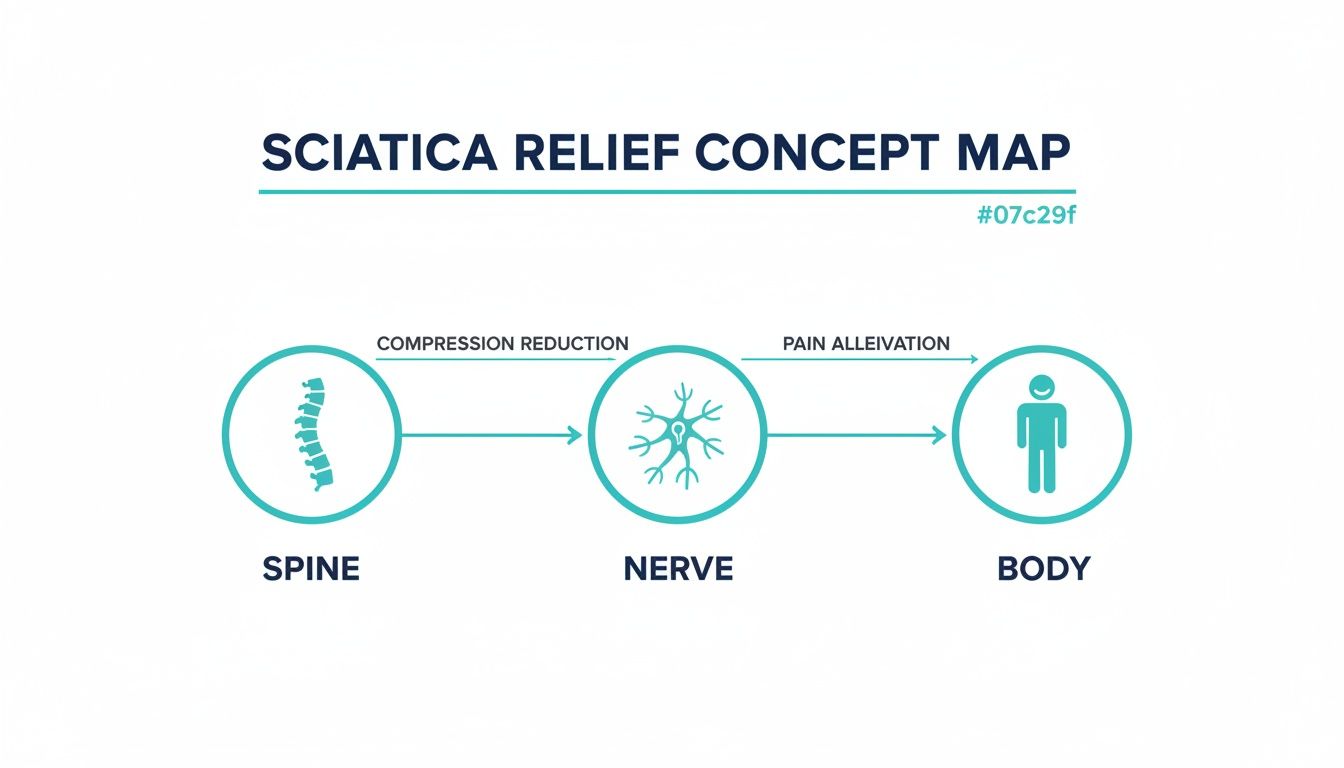
It’s a clear illustration of how correcting the root cause in your back provides a lasting solution for the pain shooting down your leg.
This is the classic technique many people associate with chiropractic care. The Diversified Technique involves a very specific, high-velocity, low-amplitude thrust applied to a spinal joint that isn't moving correctly.
You might hear a “popping” sound, which is simply the release of gas from the joint fluid, similar to cracking your knuckles. The adjustment is designed to restore proper movement, which can immediately take pressure off the nearby sciatic nerve root. This technique is excellent for addressing general spinal stiffness and misalignments that often contribute to nerve irritation.
If a bulging or herniated disc is causing your sciatica, the Flexion-Distraction technique is an incredibly gentle and effective option. For this method, you lie on a specially designed table that moves in segments while the chiropractor applies slow, steady pressure.
Imagine your spine being gently stretched and relaxed in a rhythmic, pumping motion. This creates a subtle negative pressure—almost like a vacuum effect—inside the disc.
This gentle decompression can help draw the bulging disc material back toward the center, pulling it away from the sciatic nerve. It also helps hydrate the disc and increase the space where nerves exit the spine.
Patients often find this technique very comfortable and relaxing since it involves no sudden movements. It's a powerful, non-surgical way to decompress the lower back and give the nerve the breathing room it needs.
For patients who prefer an even gentler approach or have conditions like osteoporosis, instrument-assisted adjustments are a fantastic alternative. Instead of using their hands, the chiropractor uses a small, handheld device.
A popular tool for this is the Activator Adjusting Instrument. It delivers a quick, low-force impulse to a specific spinal joint. Because the thrust is so fast, your muscles don't have time to tense up, allowing for a precise adjustment with minimal force. These instruments provide a highly targeted correction without any twisting, making them a safe and comfortable option for people of all ages.
To help you understand the differences, here’s a simple breakdown of these methods.
| Technique | What It Feels Like | How It Helps Sciatica |
|---|---|---|
| Spinal Manipulation | A quick, gentle thrust; may produce a "popping" sound. | Restores motion to stuck joints, reducing direct nerve pressure and inflammation. |
| Flexion-Distraction | A slow, rhythmic stretching or pumping of the lower back. | Creates a vacuum effect to help retract bulging discs and decompress the spine. |
| Instrument-Assisted | A light, fast tapping or clicking sensation at a specific point. | Delivers a precise, low-force adjustment to realign vertebrae without twisting. |
The effectiveness of these techniques is supported by research. Clinical studies show impressive results, with one trial documenting a 72% success rate for chiropractic treatment of sciatica. Another study on the Flexion-Distraction technique found that 79% of patients experienced significant pain relief after an average of only 13 visits. To learn more, you can read more about sciatica treatment research.
While most sciatica treatments focus on the lower back, a highly precise and gentle method looks to the very top of the spine for answers. This is the upper cervical approach, and it’s based on a simple but powerful principle: a problem at the top of your neck can create problems all the way down your spine.
Think of your body as a building. The foundation isn't at your feet—it's the very first vertebra in your neck, called the atlas. If this foundation tilts, even slightly, the entire structure has to twist and compensate to keep you upright.
This creates a chain reaction of tension down your spine. It can cause one hip to sit higher than the other, creating uneven pressure on your lower back and pelvis. For many people, this subtle imbalance is the hidden root cause of their sciatic nerve irritation.
When your head isn't sitting correctly on your shoulders, your body instinctively works to keep your eyes level with the horizon. To do this, your shoulders might become uneven, your spine might develop slight curves, and your pelvis might twist.
This constant state of compensation forces the muscles in your lower back to work overtime, leading to chronic tightness, inflammation, and eventually, enough pressure to aggravate the sciatic nerve. An upper cervical chiropractor works to correct this foundational tilt, allowing your whole body to find its balance again.
By precisely correcting the alignment at the top of the neck, we allow the rest of the spine to unwind naturally. This can remove the deep-seated stress on the lower back, giving the sciatic nerve the space it needs to finally heal.
This approach isn't about chasing lower back pain. It’s about fixing the problem that created the lower back pain in the first place. For many patients in the Waco area, this gentle method provides a long-term solution they couldn’t find elsewhere.
The upper cervical correction is one of the most gentle and specific chiropractic techniques available. If the idea of forceful twisting or "popping" makes you nervous, this method will put you at ease.
There is no cracking or forceful manipulation involved. The adjustment is an incredibly light, controlled touch applied to the side of the neck, designed to gently guide the atlas vertebra back into its proper position. Its precision comes from detailed diagnostic imaging, which allows us to calculate the exact angle needed for your unique anatomy.
Most patients are surprised by how subtle the adjustment feels, yet the results can be profound. By restoring clear communication between your brain and body, the correction signals the muscles all the way down your spine to relax and let go of tension.
This specialized approach can be a game-changer for people whose sciatica lingers despite other treatments. You might be an ideal candidate if:
You have a history of head or neck trauma: Even a "minor" car accident, fall, or sports injury from years ago can misalign the atlas.
You notice postural imbalances: Uneven shoulders, a persistent head tilt, or feeling like one leg is shorter than the other are classic signs.
Your sciatica is joined by other symptoms: Headaches, neck pain, and dizziness often stem from the same atlas misalignment. You can learn more about other common upper cervical care conditions.
You are looking for a root-cause solution: If you want to fix the fundamental reason for your pain, this method provides a path to lasting stability.
By addressing the body's control center, the upper cervical approach empowers your entire system to heal. For many, it's the missing piece of the puzzle in their journey to becoming free from sciatic pain.

Starting any new kind of healthcare can feel a little uncertain, and we understand that. That’s why we make your path to relief as clear and comfortable as possible from the moment you walk through our doors here in Waco.
Your care is a partnership, and it all starts with a detailed conversation. The first visit is dedicated to listening. We’ll discuss your health history, the specifics of your sciatic pain, and what you’ve tried so far. From there, we’ll conduct a comprehensive examination to pinpoint the source of your nerve irritation, which may include precise diagnostic imaging to get a crystal-clear picture of your spinal alignment.
Once we understand the full picture, we’ll develop a care plan tailored just for you. Your plan will outline the specific sciatica chiropractic techniques best suited to your body, a recommended schedule of visits, and clear goals for your recovery. We want you to feel confident and informed every step of the way.
For many people, this careful, non-invasive approach is a powerful alternative to more aggressive treatments. In fact, research shows just how effective it can be.
A major study found that 60% of participants who didn't get relief from other treatments "benefited from spinal manipulation to the same degree as if they underwent surgical intervention."
This highlights the long-term effectiveness of chiropractic care without the significant risks tied to surgery.
A typical adjustment session is gentle, precise, and efficient. If your care plan involves an upper cervical correction, the adjustment is just a light, controlled touch with no twisting, popping, or cracking. Our goal is to make the specific correction your body needs and then let your own healing process take over.
Immediately after an adjustment, many patients report feeling a sense of ease or relaxation. It’s also common to feel a little tired as your body begins to process the change and adapt to its new, proper alignment. You might notice some mild soreness, much like how your muscles feel after a new workout. This is a completely normal sign that your body is adapting and strengthening.
Consistency is key to getting results that last. Each adjustment builds on the one before it, gradually retraining your spine and nervous system to hold the correct alignment.
Many cases of sciatica are linked to underlying disc issues, and consistent care helps address that root problem. If you'd like to learn more, you might be interested in our guide on disc herniation relief in Waco.
Our care in Waco, TX goes beyond just getting you out of pain today. We work with you to build a stronger, more resilient spine that can better withstand the stresses of daily life. The ultimate goal is not just to resolve your current sciatica, but to help prevent future flare-ups, so you can enjoy a more active, pain-free life.
It’s normal to have questions when starting a new treatment. Feeling informed is a big part of the healing process. To help, we’ve answered some common questions we hear from patients in Waco who are considering chiropractic care for their sciatica.
Everyone’s healing journey is different. While many patients report feeling some relief within the first few visits, lasting correction takes time. Each adjustment builds on the last, retraining your spine for long-term stability. During your initial consultation at our Waco clinic, we’ll create a personalized care plan that outlines a projected timeline based on your specific condition.
The goal of a chiropractic adjustment is to be gentle, precise, and comfortable. This is especially true for the upper cervical corrections we specialize in, which involve no forceful twisting or popping. Most of our patients do not feel pain during the adjustment itself. It's normal to feel some mild soreness afterward, similar to muscle soreness after a workout, but this usually fades quickly.
When performed by a licensed and experienced Doctor of Chiropractic, it is incredibly rare for a spinal adjustment to worsen sciatica. Your safety is our top priority. Our process always starts with a thorough examination and diagnostic imaging to ensure you are a good candidate for care. This allows us to understand the root cause of your problem and design a treatment plan that is both safe and effective.
The upper cervical technique can bring profound relief, particularly when other treatments haven't worked. You might be a good candidate if:
You've tried other treatments without success.
You have a history of head or neck trauma, like a car accident or fall.
You notice postural imbalances like uneven shoulders or a head tilt.
The best way to know for sure is to schedule a consultation. A complete evaluation at our Waco office will tell us if this gentle, precise approach holds the key to the sciatica relief you’ve been searching for.
Are you ready to find a lasting solution to your sciatica pain? A local chiropractor can help you understand the root cause of your discomfort and guide you on a path to genuine healing. Schedule your new patient consultation today!